Zipping files on Apple/Mac is a chore because of all the hidden files and folders added by macOS. Like .DS_Store and __MACOSX are two of the most common files and folders that are added to zip files when compressed on macOS.
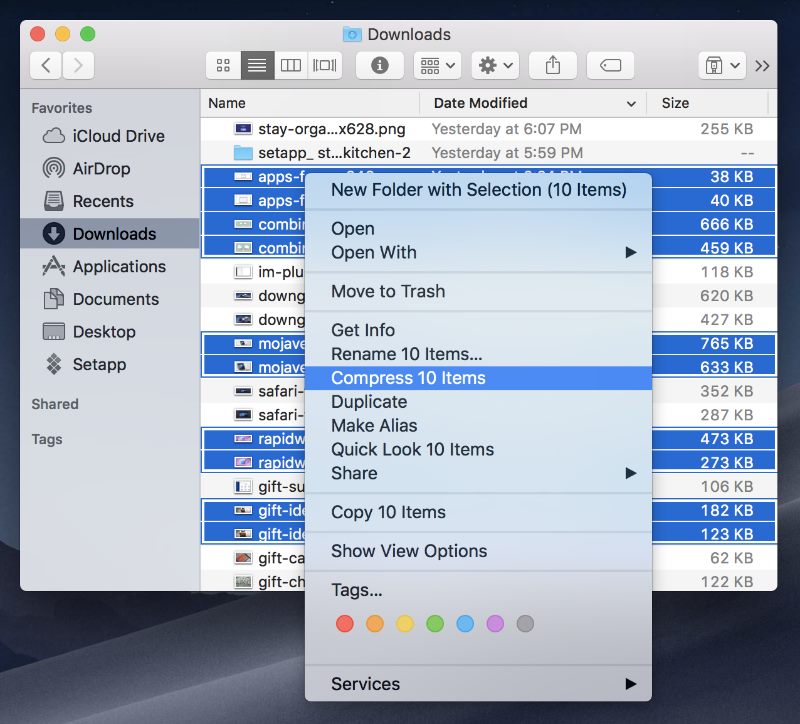
In this article, we will walk you through the steps compress (zip) and uncompress (unzip) files on your macOS. Zip files on mac Zipping/Compressing Files on macOS. Most of the operating systems have a feature to compress the files and folders into a zip file. Mac OS uses Archive Utility for this feature. Smart Folders automatically gather files by type and subject matter, and are instantly updated as you change, add, and remove files on your Mac. See also Use iCloud Drive to store documents on your Mac, iPhone, and iPad Get file, folder, and disk information on Mac Rename files, folders, and disks on Mac Delete files and folders on Mac See. The Unarchiver can open zip archives as well as open RAR files on a Mac, zip CPGZ files, bz2 bzip,.7z files,.sit, gzip gz, tar, and many other file archive formats that you may encounter when downloading data from the internet or in emails. That vast support for extracting a wide variety of file types is one of the many reasons why The. Since Mac comes with built-in Zip extractor, it will be a cakewalk for you to extract the downloaded zip file. To extract RAR files online on Mac without installing any tools, Visit the Extract.me and click on “Choose file” button to select a RAR from your Mac. Alternatively, you can also drag and drop the RAR file to make things even simpler.
The folder named __MACOSX especially is problematic because it contains duplicates of every file in the zip archive. So for example, if you use Finder to compress 20 files, the resulting zip file will contain the original 20 files, plus an additional 20 files all hidden under the /__MACOSX/ folder.
It’s a real pain and can be confusing to deal with because when you unzip the files on a Mac, the hidden files and folders are not included in the unzipped files. So you won’t be able to view them, even after you enable display of hidden files. The only way to view all the hidden files/folders is to open the zip file on a non-Mac machine, like PC/Windows or Linux.
Hidden Files
Here are some screenshots showing the hidden files and folders that are included for any folder compressed (zipped) on macOS. First screenshot shows the hidden __MACOSX directory, which is visible on PC when you open the zip file.
:max_bytes(150000):strip_icc()/003_how-to-zip-and-unzip-files-and-folders-on-a-mac-2260188-5bc7871c4cedfd005121138d.jpg "Zip Folders For Mac")
The next screenshot shows the set of duplicate files and folders that are included in zip files compressed on macOS. Notice the file names, each begin with a dot ., which makes the files hidden by default on most systems.
Now compare those previous screenshots (taken on PC) with the following screenshot (taken on Mac). Even with “show hidden files” enabled, the hidden __MACOSX folder and all the hidden files are not included (i.e., they do not exist hidden or otherwise) in the unzipped archive.
So again, all the hidden files/folders added by Mac are included in the unzipped files ONLY when the files are unzipped on non-Mac machines. Thus the confusion: Why on earth are the hidden files added in the first place? They are completely excluded when unzipping on Mac, and never needed for any reason on any other machine. In fact quite the opposite: the hidden files serve NO purpose other than to waste bandwidth, time, energy, resources, etc.
Why does macOS include hidden files in zip archives? It makes absolutely zero sense.
Zip Folder For Mac
Real Problems
This is a real problem because many people use Mac to zip files to share on the Web. Problem is that not everyone uses a Mac. So anyone downloading your zip files on their Windows, Linux, or other non-Mac is going to see all those hidden files and folders. Which are utterly useless to non-Mac devices and users.
Further, by adding a duplicate set of hidden files to the zip archive, Mac essentially is doubling the size of the download zip file, which of course wastes bandwidth, disk space, and everything else. May not be a huge deal for smaller zip files, but we’re talking about potentially millions or billions of zip files downloaded every day, needlessly bloated with useless data.
__MACOSX directory and its duplicate set of files can cause problems with things like installing WordPress plugins and other applications. So if you are WordPress/Web developer, use a version-control system to manage and package/zip your files. That way you keep all the hidden junk completely out of the picture. Alternately if you aren’t using version control, you can remove/exclude unwanted hidden files using one of the techniques below.Real Solutions
Fortunately, all the hidden garbage is not needed on any machine — including Mac — so it’s all 100% totally safe to delete. So regardless of which machine/OS you are using, you can safely delete __MACOSX and .DS_Store from any zip archive. The files literally are useless. Read on to learn some different techniques for removing the __MACOSX and .DS_Store from ZIP Files on macOS.
Use software to exclude hidden files from NEW zip archives
For new files, you can use an app such as YemuZip or any free alternative to zip compress new files without any hidden junk.
I don’t know of any apps that can retroactively remove hidden files/folders from existing zip files. If you know of any, drop a comment or send via contact form.
Use command line to exclude hidden files from NEW zip archives
On Mac you can use Terminal to easily remove all of the hidden files/folders from existing zip files. Here are some techniques that I use for my own projects.
When creating new ZIP archives, you can use the zip command to compress/zip files without any hidden files like .DS_Store and __MACOSX. Here are the steps:
- Open the Terminal app
- Navigate to the folder that contains the files you want to zip
- Type or paste the following command into Terminal*:
- Press Enter to execute and done.
The resulting zip archive will be named data.zip and located in the same directory as the original uncompressed files. The data.zip archive will not include any __MACOSX or “dot-hidden” files (i.e., file names that begin with a literal dot).
*Important: The above command will remove all dot-hidden files, including files like .htaccess and other common/useful files. So if you want to keep some hidden files and only remove the ones added by macOS, use this command instead:
cd and ls commands to navigate in Terminal.Example
To give this a real-world example. Let’s say you have a folder on your desktop called Folder that includes a bunch of files that you want to zip/compress.
First, open terminal and write following commands:
Now you have a file called data.zip on your desktop that does not include any __MACOSX or .DS_Store files. I.e., a nice clean zip file with no hidden garbage.
Use command line to remove hidden files from EXISTING zip archives
The above techniques show how to exclude hidden files when creating new zip archives. But what if you want to remove hidden files from an existing zip archive? Easy. In Terminal, navigate to the directory that contains your zip file and enter the following two commands:
And/or if you have multiple zip archives in some folder, and want to remove all hidden macOS files from all of them in bulk. Use Terminal to navigate to the folder and enter the following commands:
I use this technique for zip files I serve here at Perishable Press and elsewhere.
Tip
For a “quieter” Terminal experience, you can add the q (quiet) or qq (quieter) parameter to the previous bulk-delete command:
Cheers people.
Download 7-Zip for MacOS. 7Zip is a great app that should be included on iTunes. As productivity is a concern on all Apple devices, the development of 7Zip would be a great delight for all its users. I mean, why not? It is the most powerful and secure archiving and file compression tool in its category and field. For more resources about 7Zip for other operating systems, check out our other articles on 7Zip.
So, you are one of the opulent citizens of the society or perhaps meticulous with the software and security, thus, you prefer using Mac computers. As a matter of fact, some programs and software for Windows, Linux, and for Mac are programmed differently. This goes the same with 7Zip for Mac.
By default, Mac OS X is incapable of handling these files. But this shouldn’t be much of an issue as there are lots of other archiving tools available that can open a .7z file and other file compression formats.
The 7Zip file format is considered a better file compression format because of its high security and overall stability. It 7Zip can compress any file much better than ZIP and WinRAR or WinZip. This makes 7Zip safer and a much better choice.
Contents
- 1 A Walkthrough on 7-Zip for Mac
- 1.1 Reminder
A Walkthrough on 7-Zip for Mac
Keep on reading as we are going to walk you through on the steps for opening .7z archive files regardless of what version of Mac OS you are using. Don’t worry, it is easy and quick to do even it gets an error cannot open a file as archive sometimes. Here’s how it goes.
- Download “The Unarchiver” first. The latest version is 4.2.2 and support macOS 10.7 or later. the file is 13.6 MB. You can either download it from the Mac App Store or click here for direct download.
- The app is relatively small so you should be able to get it installed for a few seconds depending on your internet speed.
- As soon as The Unarchiver app finishes installing, open it and you will see the file association list.
- Launch the Unarchiver and there you’ll find the file association list, inform the Unarchiver to associate it with .7z files.
- The moment that you’ve associated the Unarchiver with .7z you could then double-click any .7z file on your Mac computer. It will then open and uncompress like other archive format or launch Unarchiver and just drag and drop the 7z files to the utility.
This is everything that you have to know in opening any .7z archive files saved on your Mac computer. After installing the UnArchiver and associated it with .7z 7Zip files, you may now launch the .7z archive simply by double-clicking on it. Inside the UnArchiver utility, your file will open and decompress the original 7z file. It will exit the app automatically when it is finished. It is possible to directly open the Unarchiver and open the file in the Unarchiver directly where it’ll be extracted.
Reminder
Since 7Zip archives have undergone a strong compression procedure, it sometimes takes a while in order to completely extract large 7z files. Don’t be surprised as well if the 7Zip has expanded to something bigger than the original file size as the size of the archive. This is totally normal. Just be sure that you have enough disk space to accommodate all the uncompressed data.
/how-to-zip-and-unzip-files-and-folders-on-a-mac-2260188-4c8c70f5008a40588e88c4ab3f6024ba.png "Zip Folders For Mac")
Unarchiver is a well-known solution to all kinds of archive formats available on Mac. It’s been discussed as an alternative when you have to unRAR and open RAR files in Mac OS and it can open virtually any archive format you might come across. This can include but not limited to:
- 7z
- zip
- sit
- tgz
- tar
- gz
- rar
- bzip and;
- hqx
Download Zip For Mac
Due to its expansive nature and free of charge, it is a wonderful addition to your Mac software toolkit. Well, it is comparable to a Swiss army knife but for computers.
The Complete Package
The Unarchiver provides support to every release of the Mac OS software that’s in use. This is regardless if you’re using the latest release, Sierra, macOS High Sierra, Mac OS X El Capitan, Mountain Lion, Mavericks, Snow Leopard, Yosemite, and so forth. It’ll work and can get the job done in opening and decompressing zip as well as other archive formats available.